
CIDIFA 2026: international congress in Oiapoque
UNIFAP Oiapoque Campus hosts CIDIFA 2026, an international congress on Amazonian interculturality. Submissions until July 15. Event from August 13 to 15.
What is CIDIFA?
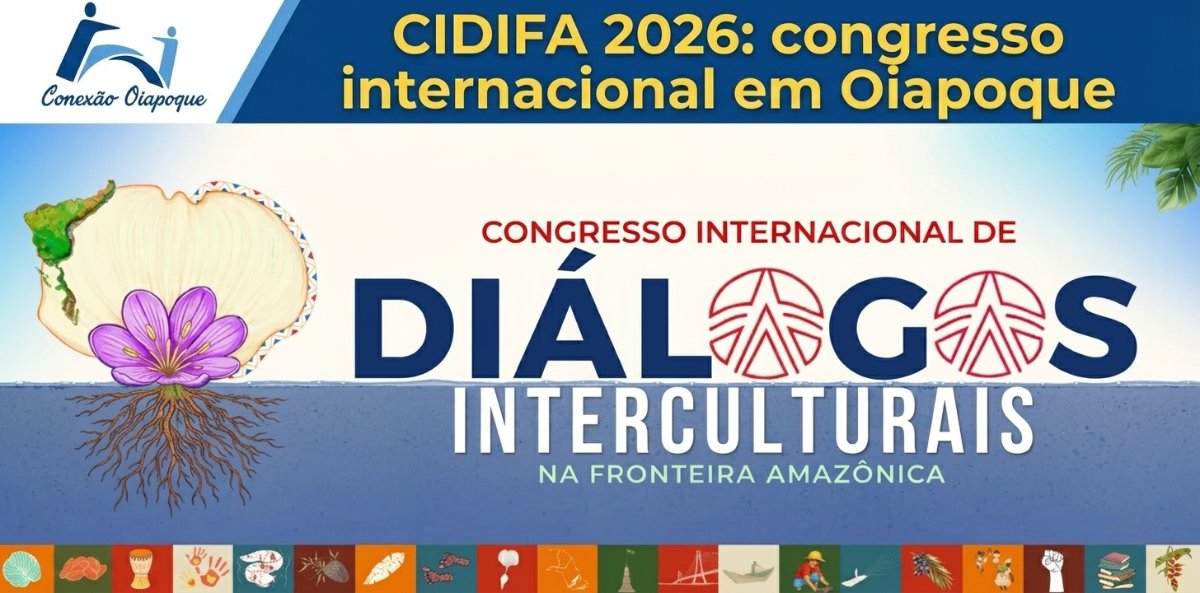
The International Congress of Intercultural Dialogues on the Amazonian Border (CIDIFA) is an academic-scientific event organized by UNIFAP's Binational Campus in Oiapoque, with support from the Program to Support Events in the Country for Basic Education (PAEPEB/CAPES). Its central objective is to promote scientific and cultural exchange among researchers, teachers, students, professionals, and society, with an emphasis on the articulation between Exact Sciences, traditional knowledge, and intercultural practices in the Amazon. The program will include lectures, mini-courses, workshops, poster sessions, and academic-scientific activities focused on intercultural education and teacher training in border contexts. The general coordination of the event is carried out by Prof. Dr. Agerdânio Andrade de Souza and Prof. Dr. Maria Adriana Leite, both from UNIFAP's Indigenous Intercultural Degree Program.
The five thematic axes
All works submitted to CIDIFA must be linked to at least one of the event's five thematic axes.
-
Axis 1 deals with Intercultural Education, Teacher Training, and Pedagogical Practices in the Amazonian Frontier.
-
Axis 2 addresses Traditional Knowledge, Natural Sciences, and Sustainability in the Amazon.
-
Axis 3 discusses Territory, Frontier, and Amazonian Sociocultural Dynamics, including Brazil-French Guiana relations.
-
Axis 4 focuses on Languages, Multilingualism, and Intercultural Dialogues in the Frontier — especially relevant for Oiapoque, a bilingual city with a strong presence of Guyanese French.
-
Axis 5, finally, covers Human Rights, Health, and Public Policies in Intercultural Contexts.
The thematic diversity reflects the richness of Brazil's northern frontier and the Binational Campus's vocation for dialogue between cultures.
How to participate and submit works
Scientific work submissions must be made exclusively through the official CIDIFA platform, available on the UNIFAP Oiapoque Campus website, until July 15, 2026. Five modalities are accepted: Scientific Communication, Experience Report, Scientific Poster, Workshop, and Lecture. Each author can submit up to 3 works, with a maximum of 3 authors per work. All participants who submit works must be regularly registered for the congress. The complete call for papers, with the mandatory templates for each modality, is available for download at www2.unifap.br/oiapoque. To follow updates on programming, registrations, and online transmission, follow Instagram @cidifaap.
Guaranteed publication with ISBN
One of CIDIFA's great attractions for researchers and postgraduate students is the publication policy for approved papers. The Scientific Communication and Experience Report modalities will be published in the Annals of the event with ISBN. The best Experience Reports — one per thematic axis — will be selected as chapters of the book "Diálogo Intercultural na Fronteira Amazônica: Formação Docente e Saberes Plurais", Volume 1. In addition, outstanding Scientific Communication works may compose Thematic Dossiers to be published in a Qualis A scientific journal in the area of Education (CAPES, 2021-2024 quadrennium). Scientific Posters will also be included in the Annals of Scientific Posters, and the best will receive a certificate of honor of merit.
Full schedule
The CIDIFA 2026 calendar is organized as follows: paper submissions are open until July 15, 2026; paper evaluation takes place between July 20 and 30; results will be announced on August 2; the final version of approved papers must be submitted by August 6; and presentations will take place on August 13, 14 and 15, 2026, in person at the UNIFAP Binational Campus in Oiapoque. Dates may be changed by the Organizing Committee upon prior announcement on official channels.
Why this matters to Oiapoque
In a binational city, surrounded by the forest, the Oiapoque River, and the rich indigenous and Guyanese presence, an international congress like CIDIFA has a significance that goes beyond the academic calendar. It puts Oiapoque on the map for scientific production about the Amazon, values local knowledge, and opens doors for partnerships with universities in Brazil and abroad. For students of UNIFAP's Binational Campus and IFAP, it is an opportunity to publish their first scientific paper without leaving the municipality. For public school teachers, it is high-level continuing education. For the city, it is visibility and recognition as a knowledge hub on Brazil's northern border. Conexão Oiapoque will closely follow all stages of the event and will provide more information about the program as the congress approaches.
Comments (0)
Share your opinion!
Log in to comment and join the discussion