

Oil in Amapá: what comes after the Morpho well
Petrobras identified hydrocarbons in the Morpho well, 175 km off the coast of Amapá. Understand the steps before any production.
What Petrobras found — and what still needs to be known
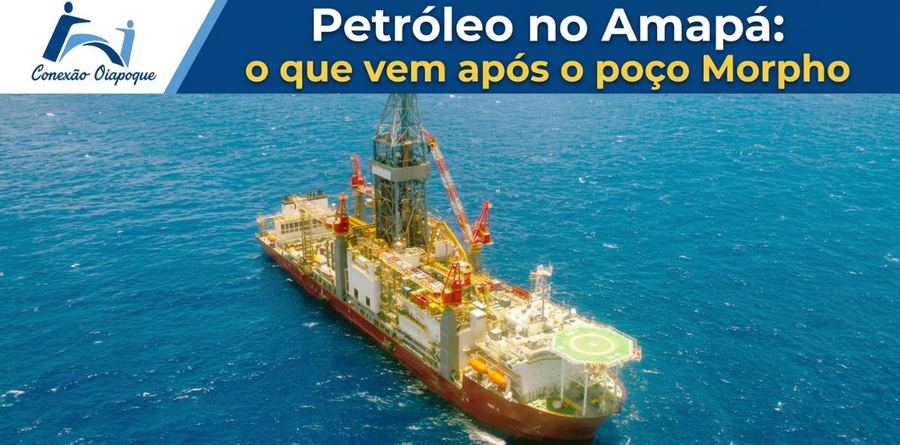
Petrobras reported the identification of hydrocarbons in the Morpho exploratory well (1-BRSA-1405-APS), in block FZA-M-59, in deep waters of the Foz do Amazonas Basin. The point is at a water depth of 2,886 meters, approximately 175 kilometers off the coast of Amapá and almost 500 kilometers from the mouth of the Amazon River. The presence was confirmed by electrical profiles and rock indications during drilling.[1]
That's why the news should be celebrated with correct information. Hydrocarbons are the family of compounds that includes oil and natural gas; their identification in the well proves an active petroleum system, but it does not, by itself, inform the size of the accumulation, the quality of the fluid, the extent of the reservoir, or whether future production would be economically viable. These are the answers that the next stage of the research needs to build.
From well to production: the path is still long
The immediate first step is to complete the drilling of Morpho. The president of Petrobras, Magda Chambriard, informed that the operation should be finalized between the end of August and the beginning of September. Afterwards, the well data needs to be integrated to delineate the discovery and evaluate its volume, characteristics, and economic potential. The company is also awaiting Ibama's analysis regarding the authorization requested for three other wells in the same block; as of the time of reporting, there was no public deadline for this decision.[2]
According to the rules of the National Agency of Petroleum, Natural Gas and Biofuels (ANP), the evaluation of a discovery occurs within the exploration phase itself. It may involve new geophysical data, additional wells, tests, and technical analyses. For this, the company submits a Discovery Evaluation Plan (PAD). In the end, the results must support an eventual Declaration of Commerciality; only after this path is a development project discussed and, further on, production.[3][4]
What changes for Oiapoque now
Geographical proximity places Oiapoque at the center of the conversation, but it does not, by itself, equate to the immediate establishment of a base, large-scale local hiring, or the generation of revenue from exploration. These definitions depend on the confirmation of commerciality, future projects, applicable licenses, and the logistical choices of the operation.
The concrete impact will begin to be drawn even before any eventual production. The region will need to monitor professional qualification, public health and service capacity, infrastructure, transparency regarding suppliers, and environmental protection. The opportunity should not be measured only by the oil found, but by the ability to transform knowledge, planning, and oversight into lasting benefits for those who live in Amapá — especially in the municipalities closest to the exploratory area.
The reactions: optimism, responsibility, and planning
Senator Randolfe Rodrigues classified the announcement as a milestone for Amapá and stated that a phase of research aimed at evaluating exploration on a commercial scale is opening up. In his statement, he associated the eventual wealth with the challenge of improving the quality of life of the population, without this dispensing with the technical and regulatory steps that are yet to come.[5]
The mayor of Oiapoque, Inácio Maciel, also defined the discovery as a historic moment for the municipality and the state. In a publication on the official profile, he cited the potential for opportunities, employment, income, business, and investments; at the same time, he advocated for public authorities to conduct the process with planning, responsibility, and respect for the environment.[6]
Furthermore, the candidates for the Government of the State of Amapá also spoke out. The current Governor Clécio Luís comments on the news as the fruit of much work and articulation, while his opponent Dr Furlan claims to be better prepared to manage this development.
All statements converge in optimism, but the moment demands a fundamental distinction: legitimate expectation is not confirmed production. The most mature public discussion is precisely one that accompanies research without anticipating results and demands institutional preparation for all scenarios.
What to follow from now on
The next milestones that deserve attention are clear: the completion of Morpho drilling; technical results indicating the extension and characteristics of the occurrence; the environmental decision on new wells; the eventual submission of a PAD to ANP; and, at a later stage, a possible Declaration of Commerciality. None of these steps is automatic, and all need to be communicated with transparency.
For Oiapoque, the news is historic as it opens a concrete long-term possibility. The work from now on is to separate fact from expectation, monitor each decision, and prepare the municipality so that, if the discovery is commercially confirmed, development is planned, environmentally responsible, and socially useful.
Sources of the investigation
[1] Agência Petrobras, communication dated 08/14/2026 about the Morpho well; [2] Band, interview with the president of Petrobras published on 08/15/2026; [3] ANP, institutional page on discovery evaluation, updated on 07/15/2025; [4] ANP, guidelines on declaration of commerciality; [5] Diário do Amapá, repercussion of Senator Randolfe Rodrigues' statement, 08/14/2026; [6] Official Instagram profile of Mayor Inácio Maciel, consulted on 08/16/2026.
Comments (0)
Share your opinion!
Log in to comment and join the discussion